
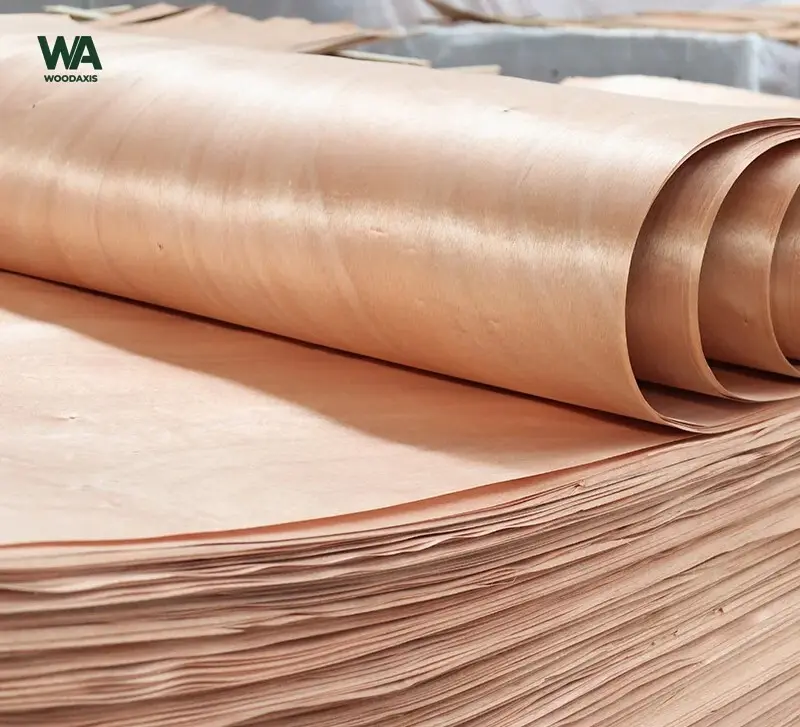
WOOD VENEER
- Name: Wood Veneer
- Size: 1270×2500 mm, 1270×2200 mm, 1270×1900 mm, 970×1900 mm or as your needs
- Thickness: 0.15 mm – 1.5 mm
- Grade: A, B, C, D
- Technics: Rotary-cut veneer
- MOQ: 1*20GP
- Moisture Content: 8%~12%
- Usage:Furniture, Building, Decoration, Flooring, etc.
- Certification: FSC, CE, EUDR, CARB, EPA
- Species: Natural Veneer, Okoume Veneer, Recon Veneer, Oak Veneer, etc.
What Is Wood Veneer?
Natural Wood Veneer is the ultimate choice for achieving the luxurious warmth and intricate beauty of solid hardwood with greater efficiency and sustainability. Each sheet is precision-sliced from hand-selected, high-quality logs, capturing the unique DNA of the tree—including its organic grain patterns, natural textures, and rich color depth.
Our veneers provide a high-end “architectural grade” finish for furniture manufacturing, interior wall paneling, and bespoke joinery, allowing you to transform ordinary surfaces into masterpieces of natural art.
Key Product Highlights:
Authentic Grain & Texture: Available in various cutting styles, including Plain Sliced (Crown Cut) for elegant cathedral patterns and Quarter Sliced for sophisticated, straight-line grains.
Premium Species Selection: We offer a wide range of world-class timbers, from the deep, dark tones of American Black Walnut and the classic strength of White Oak to exotic species like Teak and Ebony.
Excellent Workability: Expertly dried and leveled to ensure a flat, stable surface that bonds seamlessly to substrates like Plywood, MDF, or Particle Board.
Sustainability: By slicing one log into hundreds of thin veneers, we maximize the yield of precious timber, making it a more eco-conscious choice compared to solid lumber.
Consistent Quality: Every bundle is sequence-matched, ensuring color and grain consistency for large-scale architectural projects.
Professional Applications:
High-End Cabinetry: Perfect for kitchen doors, luxury wardrobes, and office furniture.
Architectural Paneling: Ideal for feature walls in hotels, lobbies, and executive boardrooms.
Automotive & Yacht Interiors: Used in premium dashboards and cabin detailing.
Musical Instruments: Enhances the aesthetic value of pianos, guitars, and high-fidelity speakers.
All Wood Veneer
Veneer Type
FAQ
1. What is the difference between Natural Wood Veneer and Recon (Engineered) Veneer?
Natural Wood Veneer is sliced directly from real timber logs, preserving the unique, organic grain and “imperfections” of nature. No two sheets are identical. Recon Veneer, on the other hand, is made from fast-growing wood that is dyed and re-glued in a mold to create a man-made pattern. While Recon offers perfect consistency, Natural Veneer is prized for its authenticity and high-end luxury feel.
2. What are the most common cutting methods and how do they affect the look?
The way a log is sliced determines the visual pattern:
Plain Sliced (Crown Cut): Sliced parallel to the center of the log, creating a “cathedral” or arched grain pattern.
Quarter Sliced: The log is cut at a 90-degree angle to the growth rings, resulting in a straight, linear grain.
Rift Cut: Often used with Oak to minimize “fleck” or “medullary rays,” providing an exceptionally clean, straight-grain look.
3. What does “Book Matched” vs. “Slip Matched” mean?
These refer to how veneer sheets are arranged:
Book Matching: Every other leaf is turned over like the pages of a book, creating a symmetrical, mirrored image.
Slip Matching: Sheets are laid side-by-side without flipping, resulting in a repeating pattern that highlights the grain’s natural slant.
4. Why does the color of my veneer samples look slightly different from the final product?
Because wood is a natural biological product, variations in soil, climate, and age cause subtle differences in color and grain even within the same species. Additionally, natural wood oxidizes and changes color when exposed to UV light and finishes. This unique variation is the hallmark of genuine wood.
5. Can I apply wood veneer directly to any surface?
For the best results, wood veneer should be bonded to a stable substrate like Plywood, MDF, or Particle Board. It is not recommended to apply thin veneer directly to solid lumber, as the natural expansion and contraction of the solid wood can cause the veneer to crack or bubble.